
Configurable products have always required two kinds of knowledge. Someone understands what the customer is trying to achieve. Someone else understands the geometry, materials, constraints and fabrication logic that determine what can actually be built.
Most software separates those worlds. Sales tools capture intent in notes and forms. CAD and computational-design tools encode technical logic. The handoff between them is where time, accuracy and context are lost.
A better interface lets natural language and explicit node logic work on the same product system.
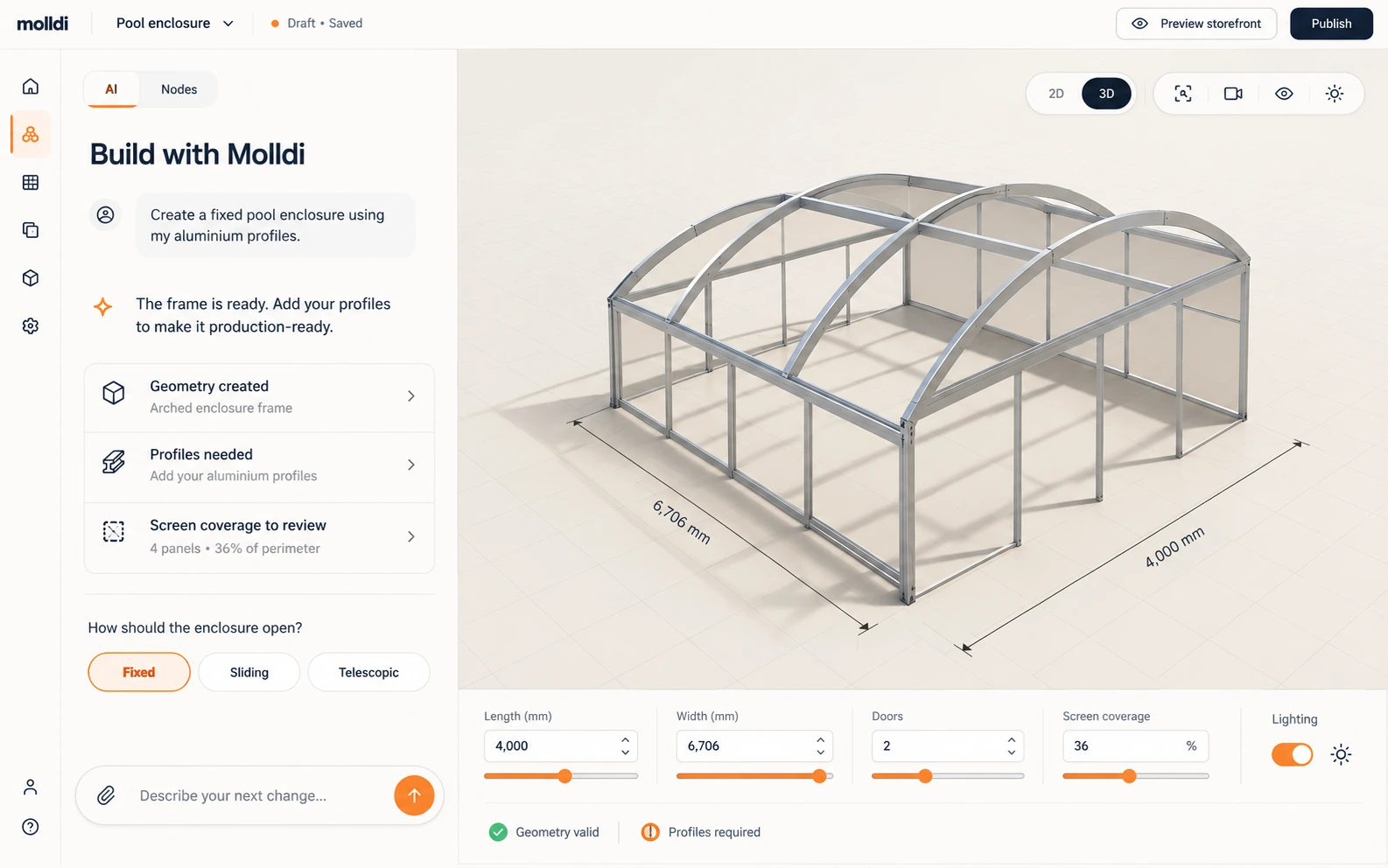
Conversation is the accessible surface
Natural language is useful because it starts with intent. A manufacturer can describe a product family, upload existing CAD information and explain the rules in the vocabulary already used inside the company. A salesperson can request a variation without learning a modeling application. A customer can describe a site or desired outcome without knowing the correct parameter names.
The conversation should not produce an untraceable model. It should propose and edit structured product logic. “Limit the maximum span to 6.2 meters” becomes a constraint. “Add a motorized roof option” becomes a selectable state connected to components, price and output.
Nodes make the logic visible
Advanced product systems need an explicit technical surface. A node editor shows how inputs, rules, selections and outputs relate to one another. It lets a technical user inspect the path from a site dimension to a profile choice, or from a finish selection to a material rate.
This matters for trust. Manufacturers need to understand why a configuration is valid, why it costs what it costs and which rule produced a manufacturing decision. Visual logic makes those relationships reviewable instead of burying them inside custom code or a black-box model.
One workspace, two ways of working
AI and nodes are not competing interfaces. They serve different moments in the same workflow.
Conversation is faster for describing intent, exploring a change and creating a first version. Nodes are stronger for auditing dependencies, tuning advanced behavior and maintaining a product system over time. A user should be able to move between them without translating the model or rebuilding the logic.
The viewer completes the loop. Every change should be visible as geometry, parameters, price and validation state. The system is not only a diagram and not only a 3D image; it is a connected definition of what the company can sell and make.
AI on the customer side
Once a manufacturer publishes the product system, the same approach can support the customer experience. The customer-facing AI does not invent a product without limits. It works inside the parameters and rules the manufacturer has approved.
A customer can describe the space, adjust requirements and see the product respond. AR can help place the result in context. Live pricing can reflect each valid change. The experience feels open, while the underlying product remains controlled.
From interface to operating system
The important outcome is not a novel way to model geometry. It is a continuous information system. Product logic connects to available materials and rates. The published configurator connects to branded commerce. Checkout preserves the final configuration. Production receives the bill of materials, drawings and manufacturing files derived from that same state.
AI makes the system easier to enter. Nodes keep it precise. Together they form an interface for physical products that is both accessible and accountable: creative enough for one-of-one results, structured enough to scale across a factory.